Pick your accommodation by its exact position and room orientation. “Near Lake Kawaguchiko” does not necessarily mean a lake-and-Fuji view.
Staying overnight at Lake Kawaguchiko gives you something a Tokyo day trip cannot: an evening by the water and another early morning to catch Mount Fuji when skies are clear. Choosing an area matters. A hotel beside Kawaguchiko Station is practical if you arrive by train or bus. A ryokan along the northeastern shore may offer the more memorable lake-and-Fuji outlook. Farther west, cottages and smaller stays trade convenience for quiet.
This guide helps you choose where to stay first, then names the ryokans and hotels we would look at in each part of the lake. No single “best hotel” suits everyone, because it depends on your budget, your dates and whether your particular room faces Mount Fuji.
Which part of Kawaguchiko should you choose?
| Area | Best for | Main advantage | Check before booking |
|---|---|---|---|
| Kawaguchiko Station and Funatsu | No-car travellers, one-night stops, early departures | Transport and meals are easier to reach | Whether the property has any lake or Fuji view |
| Azagawa and northeastern lakeshore | Onsen ryokan, lake-and-Fuji outlook | Waterfront stays and Red Line bus stops | Exact room and bath view, dinner arrangements, station shuttle |
| Kawaguchi and Oishi on the north shore | Photography and quieter lakeside time | Easy access to northern viewpoints | Bus frequency and evening dining options |
| Nagahama and western lakeshore | Cottages, driving, a quieter stay | More space and a slower pace | Car dependence, shops, food and transfer times |
| Fujiyoshida or Fuji-Q area | Chureito, Fuji-Q Highland, a wider road trip | Useful for specific activities | It is outside the Lake Kawaguchiko lakeside experience |
These are general area choices. Check each property on a map: a “Kawaguchiko” postal address can cover somewhere well beyond the waterfront. The area names in the table open Booking.com searches for that part of the lake.
Kawaguchiko Station and Funatsu: easiest without a car
If you are arriving from Tokyo by train or highway bus, staying near Kawaguchiko Station removes several small complications. You can leave luggage, walk to restaurants and start the next day's journey without arranging a taxi. The ropeway and sightseeing boat are in the broader station-side area, and the sightseeing buses leave from the station. The official Red Line route runs from there toward the northeastern and northern shores; our guide to getting around Kawaguchiko without a car explains which line serves which shore.
It is a sensible choice for a single night or an early onward departure. The trade-off is the view: a conveniently located room may look onto streets or buildings, and even a Fuji-facing window might not have the water in front of it. If your booking is chiefly about waking up to that scene, inspect the room category and the actual guest-room photographs, not just the hotel's most spectacular marketing image.
Room labels matter more here than anywhere else on the lake. Funatsu sits on the south shore with Mount Fuji behind it, so in Funatsu a “lake side” room faces the water with its back to the mountain. For the mountain itself, look for rooms labelled “Mount Fuji view”.
Choose this area if: Practical transport matters more than a private lake panorama.
Azagawa and the northeastern shore: ryokan and water views
The Azagawa lakeshore is one of the areas to investigate for an onsen stay with a view across the water. The Red Line bus map includes Azagawa Onsen Town and nearby lakeside stops, so public transport is possible during service hours. Check the current bus stops and timetable.
This is often where the choice between hotel and ryokan becomes more important than the exact neighbourhood. A ryokan may sell a package with dinner and breakfast and offer public or private bathing. Confirm what your quoted price includes, whether dinner is served at a fixed time and whether the property picks guests up at Kawaguchiko Station. Some lakeside locations are pleasant in the morning but less convenient for an unplanned late dinner.
View check: “Lake view,” “Mount Fuji view” and “Lake and Mount Fuji view” can refer to different room categories. A view from a lobby, rooftop or communal bath does not mean you will see Fuji from your room. Also check whether the bathing area is separated by gender or can be booked privately if that matters to your group.
Choose this area if: You want the overnight stay itself to be part of the Kawaguchiko experience.
Kawaguchi and Oishi: stay near the north-shore viewpoints
The northern shore suits travellers who want to spend an early morning beside the lake, particularly around the Kawaguchi waterfront, the museum area or Oishi Park. It can be quieter than the station-side cluster once the day-trip crowds leave. The Red Line serves the museums and the Kawaguchiko Natural Living Center near Oishi Park.
This area is especially appealing for photography and for blossom or autumn-leaf visits, but do not assume every property sits right on the lake. Check the walking distance from your room to your chosen shore access, and note that the sightseeing bus does not solve late-evening transport. Ask about a station shuttle or plan a taxi if you arrive after the useful bus services.
An overnight stay makes sunrise or early-morning viewing far easier than coming from Tokyo. Fuji may be clear before haze or clouds build; Japan's national tourism organisation suggests an early visit to the north side of the lake for views.
Choose this area if: Walking out for a lakeside view is a higher priority than being close to Kawaguchiko Station.
Western Kawaguchiko: space and a quieter base
Around the western parts of the lake, including Nagahama, you will find a more spread-out setting suited to cottages and slower stays. The local tourism office describes lakeside Nagahama as a comparatively quiet place to enjoy spring scenery (town guide to Oku-Kawaguchiko Sakura-no-Sato Park).
This area makes more sense if you have a car, accommodation with a reliable shuttle, or a clear plan for the Green Line bus. It can feel inconvenient if you expected to step out for several restaurant choices or return to the station on a whim after dark. Confirm parking, meal facilities and the real distance to the shore before booking.
Choose this area if: Quiet and room to settle in matter more than moving quickly between attractions.
Should you stay in Fujiyoshida instead?
Fujiyoshida can be a useful base for Chureito Pagoda, the Fuji-Q area or onward journeys by road. It is not a substitute for staying on Lake Kawaguchiko if you want to wake up beside the water. The pagoda sits in Arakurayama Sengen Park near Shimoyoshida Station, a separate excursion from the Kawaguchiko lakefront (official access guide).
For a two-night trip, you could base yourself in either town and travel between them. Choose according to the attraction you most want to see early or late in the day, and do not rely on the broad label “Mount Fuji hotel.”
Ryokans and hotels to look at first
These are the properties we would compare first, from a full onsen ryokan to a hostel by the station. The names link to their Booking.com listings or, where we could not match a single listing, to a Booking.com search for the property. Room categories, meal plans and bath rules change, so read the listing for the exact room you book.
Ryokans with onsen and Fuji views
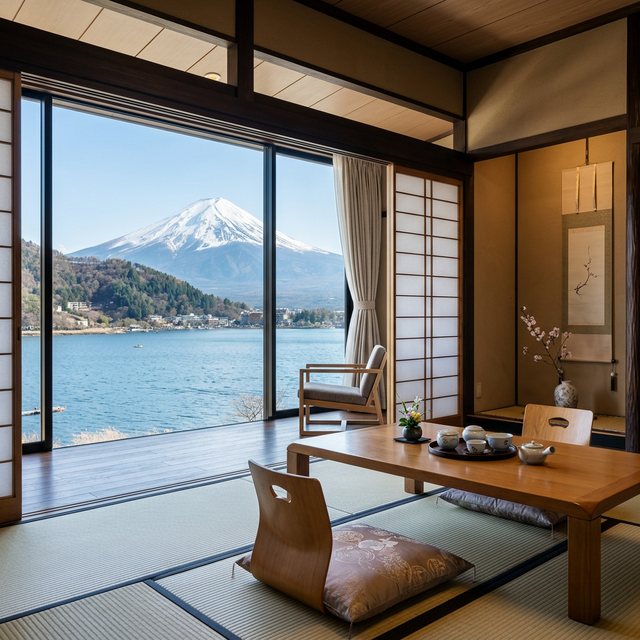
Kozantei Ubuya (Ubuyagasaki, on the north-eastern shore) is often named as the top ryokan at the lake. It is known for rooms looking across the water to Mount Fuji, and its shared and private baths face the mountain too. Confirm that your room category carries the Fuji view.
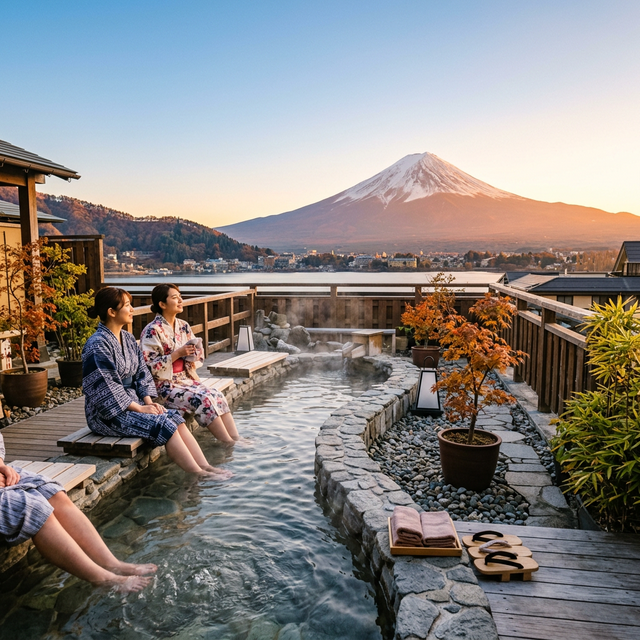
Konansou (listed on Booking.com as Fujikawaguchiko Onsen Konanso) stands near the Funatsu pier, close to the station. It combines traditional ryokan service with a modern finish, and its rooftop footbath faces the mountain. Because it is in Funatsu, apply the lake-side versus Fuji-view room check above.
For a ryokan with a private open-air bath, book early if your dates are fixed for blossom or autumn-leaf season, when the Fuji-view rooms are the first to go. Planning a winter stay around the lakeside fireworks? Check that season's dates before you book the room.
Mid-range and boutique hotels
- La Vista Fuji Kawaguchiko: a Provence-themed hotel on a hillside, with elevated views toward Mount Fuji and a European feel.
- Fuji View Hotel: one of the oldest hotels in the area, set in large grounds with its own mini-golf course and cherry trees.
Budget stays and guesthouses
Staying near the station gives you the easiest transport and usually lower prices.
- K's House Mt. Fuji: a well-run hostel with private rooms and a sociable common area. The same group runs a separate lakeside hostel, K's House Fuji View, so check which of the two you are booking.
- The Garden Hotel: clean, minimalist apartments, some units with views of Fuji, for less than most lakeside hotels.
Is a Fuji-view onsen worth paying extra for?
It can be, particularly if you plan to spend time at the property instead of using it only to sleep. A bath looking toward Mount Fuji is memorable when the mountain is visible, but visibility is never guaranteed. Before paying a premium, establish exactly where the advertised view appears: your room, a shared bath, a private bath, a terrace, or only certain facilities.
Onsen rules vary by property. If you have tattoos, need step-free access, want a private bath or are travelling with children, ask the hotel directly about its current arrangements. Day-use bathing is another option if an onsen hotel does not fit your budget; JNTO notes that some Fuji-area resorts offer same-day access (JNTO on bathing in the Fuji area). Our Kawaguchiko onsen guide covers the baths in more detail.
What to check before you book
- Exact room type: Does your booked category promise the view, or is it only available elsewhere in the property?
- Direction and foreground: Is the claim “Fuji view,” “lake view,” or both? Ask for an explanation of the room layout if the photographs are unclear.
- Transport after arrival: Is there a shuttle from Kawaguchiko Station? When does it stop running?
- Meals: Are dinner and breakfast included? Can you arrive in time for dinner service?
- Bath access: Public or private, whether a reservation is required, the tattoo policy and accessibility.
- Cancellation terms: Consider a flexible rate if clear Fuji views are the main reason you are paying more.
- Actual map position: A wide-area Fuji Five Lakes listing does not mean the property is on Lake Kawaguchiko.
How many nights should you stay?
One night is enough to enjoy an evening on the lake and an early-morning view. Two nights make sense if you want to visit another of the Fuji Five Lakes, add Chureito Pagoda, spend time at an onsen or give yourself more weather flexibility. If you only need to see the main lake spots and have flexible transport from Tokyo, a day trip can work; compare the cost and effort in our Tokyo to Kawaguchiko guide.
For most first-time visitors without a car, the choice comes down to station convenience or a lakeside stay. Pick the station if you will be out all day and leaving early. Pick a carefully checked north or northeast shore room if the view and a slower morning are the reason you are staying overnight.
Information checked September 2026. Room views, shuttle services, bath rules and meal packages vary by property and booking category; confirm them directly before reserving.